
 AETHER / CORE
HOUSE IX · AETHER Core Hoodie — Collection 01$64.99
VIEW PRODUCT

HOUSE IX / AETHER
VISION · INNOVATION · POSSIBILITY Ideas, exploration and imaginative design inform AETHER Core apparel.

01 / AETHER / AVAILABLE NOW
Three everyday essentials. Explore the AETHER hoodie, oversized tee and joggers in the current collection.
 HOUSE IX / RESEARCH
AETHER
ENTER R&D +
 FUTURE CONCEPT
HOUSE IX / AETHER — DIGITAL R&D / AETHER
THE CROSSOVER is Aether's proposed cooperative game linking digital and physical play. THE NEXUS is the wider R&D hub envisioned for developing games, interfaces and immersive technology. Select a tab for the concept; open the research archive for deeper plans.
EXPLORATORY IDEAS · NOT CONFIRMED DEVELOPMENTS
A HOUSE FOR NEW POSSIBILITIES
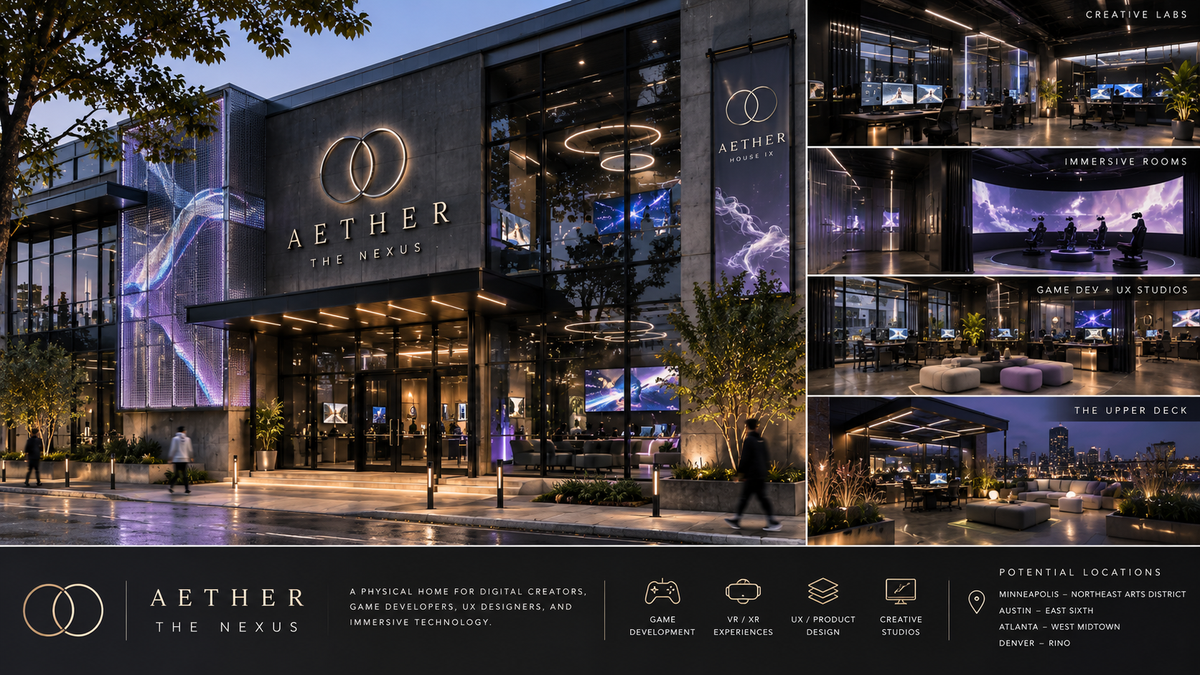
The Nexus is Aether's envisioned real-world home for games, UX, spatial design, digital experiences and experimental technology. A place where ideas move from a screen into spaces members can explore, test and improve.

01 / THE FUTURE DIGITAL HOUSE
Picture a practical two-level tech studio built around making, not just watching. The selected concept pairs dark concrete and glass with Aether's dual-circle emblem, accessible entrances, visible maker spaces and subtle lavender lighting. It is intentionally different from the Atrium's central hub and Gustiq's hospitality setting.
02 / DIGITAL CREATION & PLAYTESTING
Creator workstations and UX testing tables sit alongside game-design labs, small VR/XR rooms, interactive prototype benches and a controlled motion-capture area. Aether members can build projects of their own; Ember, Tide and Vanta members could join to prototype events, spatial audio and practical digital experiences.
03 / ARI · LEAD-DEVELOPER GUIDE
Ari is the lead developer and creative guide for Aether's story. Her focus is turning imagination into useful technology—games, interfaces, interactive worlds and tools others can build upon. She represents Aether's curiosity, but the House grows through every creator's contribution.

04 / FROM PILOTS TO A REAL LOCATION
A small playable prototype, workshops and pop-ups could help Aether test demand for a permanent studio. The future Upper Deck is envisioned as a quiet member-focused project lounge with technology previews and creator showcases. The building, access, dates and funding remain possibilities, not confirmed outcomes.
CONCEPT STUDY · PHYSICAL-SPACE PLANS DEPEND ON PROPERTY SUITABILITY, PARTNERSHIPS, DEMAND, FUNDING, SAFETY, AND LEGAL APPROVALS.
01 / RESEARCH & DEVELOPMENT VISION
The Nexus is Aether's proposed physical digital-creation hub where members from every House could make and test games, UX interfaces, immersive exhibitions, spatial media, and XR experiences. Its first research pathway can start with THE CROSSOVER, a small browser-to-physical cooperative game, before studying the cost and demand of a dedicated location.
A shared location for accessible game creation, UX testing, practical immersive technology, and collaboration might offer greater long-term value than a one-off entertainment attraction. Small software and hardware pilots should validate real demand before any property commitment.
A playable pilot prototype and a Nexus feasibility brief covering interest, space requirements, equipment, accessibility, potential districts, and cost scenarios. A prior roughly $6,500 research-pilot illustration does not represent the cost of opening the building.

PROPOSED DEVELOPMENT PATH
Collect creator needs, survey potential partners, and map equipment and accessibility requirements.
Develop the Crossover prototype and run small supervised digital/immersive playtests.
Test workshops or pop-ups using rented spaces and evaluate demand and operating costs.
Study suitable properties, financial feasibility, and a potential phased Aether location.
The Crossover and other pilots could inform a practical Aether building with shared developer desks, UX labs, enclosed VR rooms, a small motion-capture area, demo spaces, equipment storage, and a future Upper Deck creative lounge.
AETHER / MIXED-REALITY GAME RESEARCH / 001
Solve collaborative puzzles to reconnect four House-inspired systems.
A token or QR code could connect the game to a responsive projected environment.
02 / THE FUTURE PHYSICAL EXPERIENCE
Possible facilities that could make this research or product tangible in the future.
The Nexus would be a real-world home for Aether's digital side of HOUSE IX. Members could prototype indie games, design websites and interfaces, explore spatial computing and XR, and present interactive projects to other Houses. Ari would serve as Aether's lead-developer guide, helping shape the space's learning and development culture.
Use the approved second concept as the architecture reference: an adaptable two-level concrete-and-glass urban tech building with restrained geometric lighting, practical production rooms, warm-lit shared work areas, a selective lavender/gold accent palette, and the double-ring Aether emblem. Distinct from Gustiq's botanical hospitality look and the atrium's central gathering architecture. Avoid imaginary holograms or nonfunctional sci-fi structures.
Research zoning for creative studios and events, structural and occupancy limits, accessible circulation, power and cooling, wired high-speed internet, secure equipment storage, VR clear zones, emergency egress, privacy controls for sensors/motion capture, headset hygiene, acoustic separation, safety staff, realistic lease/buildout costs, and permitted rooftop access if an Upper Deck is pursued.
03 / FUTURE LOCATION EXPLORATION
Early considerations, not properties under contract or approved location announcements.
Explore an adaptable industrial studio or creative-tech property near local artists, small studios, and collaborative workspaces.
TO VERIFY BEFORE SELECTINGCheck practical floorplan, electrical/network capacity, availability, commercial use, community demand, lease costs, accessibility, and equipment buildout.
Study creative-tech and game-development connections in a mixed-use urban setting suited to small studios and workshops.
TO VERIFY BEFORE SELECTINGVerify commercial property suitability, local demand, permitting, sound/privacy standards, access, and capital requirements.
Explore adapted warehouses and maker-oriented cultural settings for collaborative tech, games, and media experiences.
TO VERIFY BEFORE SELECTINGVerify appropriate zoning, tech infrastructure, site costs, transport, accessibility, and operational viability.
Consider adaptive-reuse creative spaces for digital installations, playable demos, and smaller creator workshops.
TO VERIFY BEFORE SELECTINGVerify availability, network/electrical infrastructure, event permissions, accessible rooms, and market economics.
04 / DEVELOPMENT JOURNAL
Updates can be added here as work progresses.
The physical location is the long-term focus. The Crossover remains a proposed browser-to-physical game pilot that could teach Aether about interaction design, collaboration, accessibility, and equipment needs. Early research would inform whether The Nexus can responsibly become a real property and community studio.
PHASE 01 — DISCOVER: enter a browser mission with touch or keyboard controls. PHASE 02 — SOLVE: cooperate across Ember, Vanta, Tide, and Aether relay puzzles, earning in-game progress only. PHASE 03 — CROSS: scan a physical Gate token or enter a code in a supervised pop-up to continue the mission. PHASE 04 — ACTIVATE: trigger projection, lights, or visual feedback from physical interaction. PHASE 05 — REFLECT: see a game completion state and provide optional feedback. No paid voting, loyalty points, or purchases are tied to mission completion.
Planning research: recruit roughly 20–30 opt-in browser testers and 10–15 participants for a controlled, optional physical Gate trial. Record mission understanding, 10–15-minute completion, response latency, co-op enjoyment, replay intention, controls/accessibility, setup/breakdown time and safety. Preliminary targets—not completed results—could be 80% successful first-run completion, 4.2/5 enjoyment, and under two minutes of instructor assistance per team. Provide a non-projection option for accessibility and sensory comfort.
Stage 1: storyboard the original puzzle game and develop a small web playable. Stage 2: connect printed QR cards or optional NFC tokens to game state. Stage 3: test a projector and simple reactive interaction station at a controlled venue; evaluate cameras/sensors only if they genuinely improve play. Stage 4: run supervised tests, revise the design, and assess whether an immersive pop-up or permanent Aether Showcase is viable. Schedules and platform choices are provisional.
Planning allowances, not vendor quotations or committed spending: game/software prototype $2,800; original visuals/sound $850; projector/display trial $700; QR/NFC tokens and physical props $350; limited pilot space $500; playtest research/accessibility $550; event and equipment safety/insurance allowance $250; contingency $500. Total $6,500. Future custom electronics, true holographic displays, staffing, licensing, and commercial-scale installations could cost substantially more.
The architectural concept shows a buildable creative-tech site with game and UX studios, VR/XR rooms, and a possible Upper Deck. Ari is the lead-developer guide, but the House is powered by contributions from many creators. Ember could prototype interactive events, Tide spatial sound/media, and Vanta practical digital learning tools. The exterior and amenities remain illustrative; no building or access is secured.
Use Ari's supplied original image exactly: wavy dark hair, warm tinted glasses, light-grey Aether hoodie and joggers, double-ring emblem, and tablet. Ari represents the practice of turning ideas into usable digital creations, collaborating with creators across the other Houses. This is a story/brand role, not an announced employee or staff biography.
HOUSE IX / COMMUNITY & FUTURE UPDATES
Stay connected to AETHER apparel, news and R&D research milestones. You can shop all four House collections regardless of which House you follow.
House affiliation is recorded for newsletter interest. Automated order attribution and R&D profit allocation are still being developed.
Email updates only. No membership purchase required. Privacy policy

